5. Cross Product
c. Area
Parallelogram
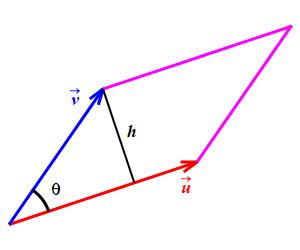
Consider a parallelogram whose sides are the vectors \(\vec u\) and \(\vec v\). Take \(\vec u\) as the base. Let \(\theta\) be the angle between these vectors.
The area of the parallelogram is the product of its base and its height \[ A_{\textstyle\diamond}=bh \] where the base is \(b=|\vec u|\) and the height is \(h=|\vec v|\sin\theta\). Thus \[ A_{\textstyle\diamond}=bh=|\vec u|\,|\vec v|\sin\theta \] However, this is is just the length of the cross product \(|\vec u\times\vec v|\). Therefore:
The Area of a Parallelogram with adjacent edges \(\vec u\) and \(\vec v\) is: \[ A_{\textstyle\diamond}=|\vec u\times\vec v| \]
Find the area of the parallelogram with adjacent edges \(\vec u=\left\langle 2,3,1\right\rangle\) and \(\vec v=\left\langle 2,0,-1\right\rangle\).
The cross product is \[\begin{aligned} \vec u\times\vec v &=\left\langle 2,3,1\right\rangle\times\left\langle 2,0,-1\right\rangle \\ &=\begin{vmatrix} \hat\imath & \hat\jmath & \hat k \\ 2 & 3 & 1 \\ 2 & 0 & -1 \end{vmatrix} =\hat\imath(-3)-\hat\jmath(-2-2)+\hat k(-6) \\ &=\left\langle -3,4,-6\right\rangle \end{aligned}\] So the area is \[ A_{\textstyle\diamond}=|\vec u\times\vec v|=\sqrt{9+16+36}=\sqrt{61} \]
Find the area of the parallelogram with adjacent edges \(\vec a=\left\langle 4,3,2\right\rangle\) and \(\vec b=\left\langle 1,2,3\right\rangle\).
\(A_{\textstyle\diamond}=5\sqrt{6}\)
The cross product is \[\begin{aligned} \vec a\times\vec b &=\begin{vmatrix} \hat\imath & \hat\jmath & \hat k \\ 4 & 3 & 2 \\ 1 & 2 & 3 \end{vmatrix} =\hat\imath(5)-\hat\jmath(10)+\hat k(5) \\ &=\left\langle 5,-10,5\right\rangle \end{aligned}\] So the area is \[ A_{\textstyle\diamond}=|\vec a\times\vec b|=\sqrt{25+100+25}=5\sqrt{6} \]
Triangle
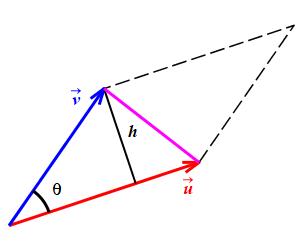
A triangle is just half of a parallelogram.
The Area of a Triangle with adjacent edges \(\vec u\) and \(\vec v\) is: \[ A_\Delta=\dfrac{1}{2}|\vec u\times\vec v| \]
Find the area of the triangle with vertices \(A=\left\langle 3,1,0\right\rangle\), \(B=\left\langle 3,0,2\right\rangle\) and \(C=\left\langle 4,1,3\right\rangle\).
\(A_\Delta=\dfrac{1}{2}\sqrt{14}\)
Two adjacent edges are \[\begin{aligned} \overrightarrow{AB}&=B-A =\left\langle 3,0,2\right\rangle-\left\langle 3,1,0\right\rangle =\left\langle 0,-1,2\right\rangle \\ \overrightarrow{AC}&=C-A =\left\langle 4,1,3\right\rangle-\left\langle 3,1,0\right\rangle =\left\langle 1,0,3\right\rangle \end{aligned}\] Their cross product is \[ \overrightarrow{AB}\times\overrightarrow{AC} =\begin{vmatrix} \hat\imath & \hat\jmath & \hat k \\ 0 & -1 & 2 \\ 1 & 0 & 3 \end{vmatrix} =\hat\imath(-3)-\hat\jmath(-2)+\hat k(1) \] So the area is \[ A_\Delta =\dfrac{1}{2}\left|\overrightarrow{AB}\times\overrightarrow{AC}\right| =\dfrac{1}{2}\sqrt{14} \]
You can also practice computing the area of a triangle using vectors and cross products in 3D by using the following Maplet (requires Maple on the computer where this is executed):
Heading
Placeholder text: Lorem ipsum Lorem ipsum Lorem ipsum Lorem ipsum Lorem ipsum Lorem ipsum Lorem ipsum Lorem ipsum Lorem ipsum Lorem ipsum Lorem ipsum Lorem ipsum Lorem ipsum Lorem ipsum Lorem ipsum Lorem ipsum Lorem ipsum Lorem ipsum Lorem ipsum Lorem ipsum Lorem ipsum Lorem ipsum Lorem ipsum Lorem ipsum Lorem ipsum